
News & Insights · 8 November 2026
The Future of Accountancy: Navigating the Digital Frontier and What Modern Clients Truly Want
AI, cloud collaboration and strategic advice are changing what you can expect from your accountant. Here is where the industry is heading.
Call 01778 252712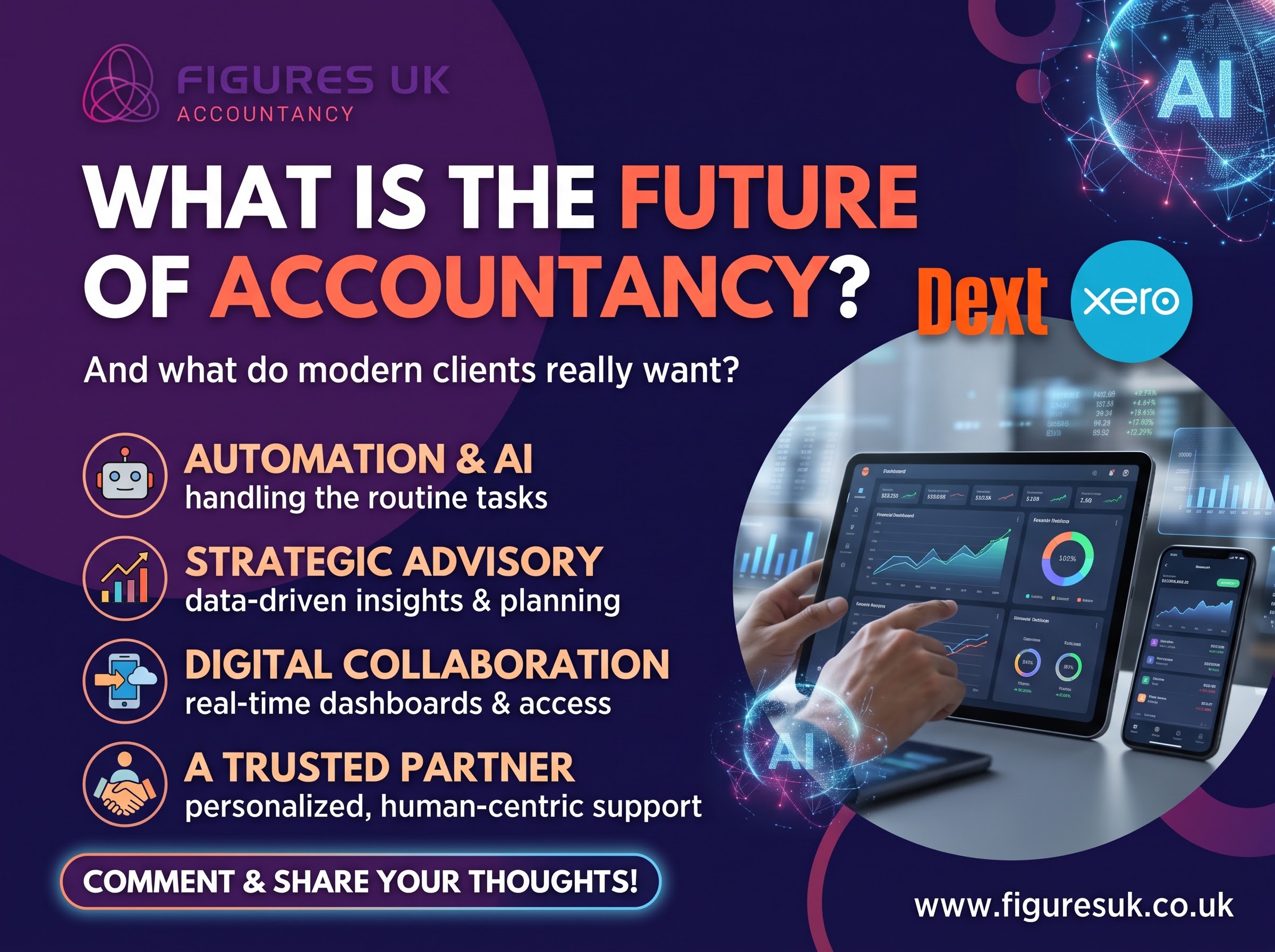
The accounting profession is undergoing its most significant and rapid transformation in decades. For centuries, the image of the accountant was deeply tied to historical record-keeping—meticulously balancing ledgers, tracking past expenditures, and ensuring compliance with tax authorities. Today, that traditional paradigm is being entirely rewritten. As we look ahead, the landscape of finance is evolving at breakneck speed, driven by technological innovation and shifting client expectations.
For business owners, this evolution begs a critical question: what does the future of the accountancy sector actually look like, and more importantly, how will it change the way you run your business? To understand where we are going, we must look at the intersecting forces of artificial intelligence, cloud computing, and the growing demand for human-centric business strategy. Here is a comprehensive look at where the industry is heading and the elevated expectations clients have for their modern accountants.
Automation & AI
Handling the routine tasks
Strategic Advisory
Data-driven insights & planning
Digital Collaboration
Real-time dashboards & access
A Trusted Partner
Personalised, human-centric support
Automation Doing the Heavy Lifting
The most immediate and visible shift in the accountancy sector is the rapid acceleration of automation and artificial intelligence. For generations, a significant portion of an accountant’s day was consumed by manual data entry, reconciling bank statements line by line, and sorting through physical receipts. Those days are rapidly coming to an end. AI and machine learning algorithms are now increasingly handling routine compliance activities, transaction processing, and complex data categorization.
Tasks that previously consumed hours of manual effort are now being completed in mere minutes. Optical Character Recognition (OCR) software—a technology that Figures UK pioneered the use of with platforms like Dext back in 2012—can now read, extract, and categorize data from invoices and receipts with near-perfect accuracy. Bank feeds automatically pull transaction data directly into accounting ledgers in real-time.
But what does this mean for the client? First and foremost, it means a drastic reduction in human error. Automated systems do not get fatigued, they do not transpose numbers, and they do not lose paper receipts. Workflows are streamlined, meaning that the foundational bookkeeping of a business is always up-to-date. Clients no longer have to wait until the end of the month—or worse, the end of the financial year—to see where their finances stand. The heavy lifting is done in the background, continuously and quietly, ensuring that the financial bedrock of the business is rock solid.
Furthermore, this automation democratizes enterprise-level financial management. Small and medium-sized enterprises (SMEs) now have access to the kind of rapid financial processing that was once exclusively available to massive corporations with entire floors of finance staff.
The Rise of the Strategic Advisor
Perhaps the most exciting byproduct of automation is what it allows accountants to do with their newly freed-up time. With technology taking over the repetitive tasks, the role of the accountant is experiencing a fundamental metamorphosis. We are shifting away from pure number-crunching and historical reporting to deliver high-value, forward-looking advisory services.
Modern clients no longer just want to know what happened in the past. Having an accountant tell you that you made a profit six months ago is mildly interesting, but it is not entirely actionable. Today’s business owners expect predictive forecasting, data-driven insights, and strategic guidance to help navigate the complexities of business growth. They want to know what their cash flow will look like next quarter, not just what it looked like last year.
This is the era of the accountant as a virtual Chief Financial Officer (vCFO). Armed with real-time data, modern accountants are utilizing sophisticated software to run scenario planning. What happens to our margins if supply chain costs increase by 15%? Can we afford to hire three new staff members in Q3? How will a new product launch impact our end-of-year tax liabilities? These are the questions the future accountant answers.
By analyzing trends, identifying financial bottlenecks before they become critical issues, and structuring tax-efficient growth strategies, the accountant becomes an indispensable partner in the boardroom. The future of accountancy lies in interpreting the data that the AI gathers, turning raw numbers into a coherent, strategic narrative that empowers business owners to make bold, informed decisions with absolute confidence.
Seamless Digital Collaboration
In our personal lives, we are accustomed to frictionless digital experiences. We can order groceries, hail a ride, and manage our personal banking from a smartphone with just a few taps. Business owners rightly expect this same level of convenience and seamless integration from their professional service providers. The future of accountancy is heavily reliant on flawless digital collaboration.
The modern client expects their financial administration to be as simplified and unobtrusive as possible. The days of physically dropping off a shoebox of receipts to an accountant’s office are obsolete. Today, collaboration happens in the cloud. Ecosystems built around platforms like Xero allow for a synchronized, always-on connection between the business owner and their financial team.
Clients expect secure, intuitive ways to share sensitive documents, approve payroll, and review tax returns from anywhere in the world. Moreover, they demand real-time access to high-quality performance dashboards. Visualizing data is crucial; a modern client wants to log into an app and instantly see a visually engaging dashboard that highlights their cash position, outstanding invoices, and monthly burn rate at a single glance.
This level of digital integration also means that the accountant is no longer a once-a-year visitor but an integrated part of the daily business workflow. Through Application Programming Interfaces (APIs), the accountant can connect a client’s point-of-sale system, inventory management software, and e-commerce platform directly into the central accounting ledger. This creates a unified, single source of truth for the business’s financial health, breaking down silos and allowing for seamless, real-time collaboration that moves at the speed of modern commerce.
A Trusted Confidant Who Listens
It is easy to look at the rise of AI, cloud computing, and automated workflows and assume that the future of accounting is entirely digital and devoid of human interaction. However, the exact opposite is true. The paradox of the digital age is that as automation handles the cold, hard numbers, the deeply human skills of empathy, intuition, and communication become exponentially more valuable.
Technology is phenomenal at providing the answers, but it requires a human to ask the right questions. Business owners are incredibly busy, carrying the weight of their company’s success, the livelihoods of their employees, and the financial security of their own families on their shoulders. Running a business is inherently stressful and often lonely. Ultimately, clients want an accountant who is more than just a vendor; they want a trusted confidant.
They want a professional who actively listens to their unique, nuanced problems. A machine can tell you that cash flow is tightening, but a human accountant understands the stress that this causes the business owner. A great accountant acts as a sounding board, offering empathetic, tailored advice rather than dispensing rigid, one-size-fits-all solutions. They take the time to understand the business owner’s personal goals—whether that is preparing the business for a lucrative exit, transitioning it to the next generation, or simply optimizing it so the owner can spend more time with their family.
In times of economic uncertainty, regulatory changes, or sudden market shifts, business owners turn to their accountants not for algorithmic outputs, but for reassurance, context, and a steady hand. The ability to translate complex financial jargon into plain, actionable language while understanding the emotional and psychological realities of entrepreneurship is a skill that no AI will ever replicate.
Embracing the Hybrid Future
The future of accountancy isn’t a dystopian vision of robots replacing financial professionals; rather, it is a synergistic future where accountants work alongside powerful AI to become stronger, more insightful, and more responsive business partners. By embracing automation for routine tasks, leveraging cloud technology for seamless collaboration, and elevating their role to that of a strategic, empathetic advisor, accountants are perfectly positioned to guide businesses through the complexities of the 21st-century economy.
At Figures UK, we have been embracing this future for over a decade, recognizing early on that technology is the key to unlocking better human relationships and superior business outcomes. The firms that thrive in the coming decades will be those that master the technology without losing sight of the human being behind the balance sheet.
As we continue to navigate this exciting digital frontier, we want to hear from the business community. What do you think is the single most important trait an accountant can have in the digital age? Are you looking for more tech integration, deeper strategic advice, or simply a partner who understands your vision? Drop your thoughts in the comments below and share this post with your network!
Want an accountant who has the tech and the time for you?
Call us on 01778 252712 or PM us and we will talk you through how it works. No jargon, promise.
Call 01778 252712Need help with this?
Get In Touch
Get In Touch With Us
Want a fixed monthly quote or a quick chat about switching accountants? Send us a message — we'll reply with clear next steps.
Worried about switching? Don't be.
You can move to Figures UK at any point in the year — no need to wait for year end. We handle the entire handover, including moving your records and transferring everything to HMRC, so the switch is seamless and stress-free for you.