
Corporation Tax Returns: Complete Guide to CT600 Filing
Understand filing deadlines, tax calculations, and HMRC compliance requirements for your limited company. Expert guidance for Peterborough and Cambridgeshire businesses.
The submission of corporation tax returns is one of the most important annual responsibilities for every UK limited company. Whether you're running a small family business in Peterborough or managing a growing enterprise across Cambridgeshire, understanding the filing process, deadlines, and requirements can save you from costly penalties and ensure HMRC compliance. This guide walks you through everything you need to know about filing your company tax return accurately and on time.
Understanding Corporation Tax Returns in the UK
Corporation tax returns differ significantly from personal self-assessment returns. When you submit a corporation tax return, you're declaring your company's profits, losses, and tax liability for a specific accounting period.
The official form used is the CT600, which HMRC provides with detailed guidance on how to complete each section. Unlike personal tax returns, the submission of corporation tax returns requires you to attach your full statutory accounts and detailed computations showing how your taxable profit was calculated.
What Must Be Included
- ✓The completed CT600 form itself
- ✓Your company's statutory accounts
- ✓Tax computations showing adjustments from accounting profit to taxable profit
- ✓Any supplementary pages relevant to your company (for example, CT600A for charities, CT600C for group companies)
The official CT600 form contains detailed instructions for each box, but many business owners find the technical language challenging without professional support.

Filing Deadlines and Payment Dates
Timing is absolutely critical when it comes to the submission of corporation tax returns. Missing deadlines can trigger automatic penalties, even if you have no tax to pay.
Your company must file its CT600 return within 12 months of the end of your accounting period. This is your statutory filing deadline. However, your tax payment deadline is much earlier.
Payment vs Filing Deadlines
| Deadline Type | Time Limit | Penalty for Missing |
|---|---|---|
| Tax payment | 9 months and 1 day after period end | Interest charged daily |
| Return filing | 12 months after period end | £100 minimum penalty |
| Late filing (3 months) | 15 months after period end | Additional £100 penalty |
Example: If your accounting period ended on 31 March 2026, your corporation tax payment would be due by 1 January 2027, but your return filing deadline wouldn't be until 31 March 2027. Planning ahead is essential.
Large companies with profits over £1.5 million must pay corporation tax in quarterly instalments, which adds another layer of complexity to submission planning.
How to Submit Your Corporation Tax Return
The submission of corporation tax returns must be done electronically. HMRC stopped accepting paper CT600 forms years ago, meaning every company must use either:
1. HMRC's own online filing service
Basic and free, but limited functionality
2. Commercial software
That integrates with HMRC (such as Xero, which Figures UK use for streamlined submission)
3. A tax agent or accountant
Who files on your behalf through their own portal
Most small businesses find the DIY approach time-consuming and risky. The CT600 contains over 100 boxes, and a single error can trigger an HMRC enquiry.
Filing Through an Agent
When you work with an accounting firm like Figures UK, the submission of corporation tax returns becomes part of your annual compliance package. Your accountant prepares your statutory accounts, calculates your tax liability, and submits everything directly to HMRC on your behalf.
This approach ensures:
- ✓Accuracy across all linked forms and schedules
- ✓Professional review of tax-saving opportunities before submission
- ✓Timely filing well ahead of deadlines
- ✓Expert handling of any HMRC queries
Calculating Your Corporation Tax Liability
Before you can complete the submission of corporation tax returns, you need to know exactly how much tax your company owes. This isn't as simple as applying the corporation tax rate to your net profit.
Corporation tax rates for 2026:
- •Small profits rate: 19% (profits up to £50,000)
- •Main rate: 25% (profits above £250,000)
- •Marginal relief: Tapered rate between £50,000 and £250,000
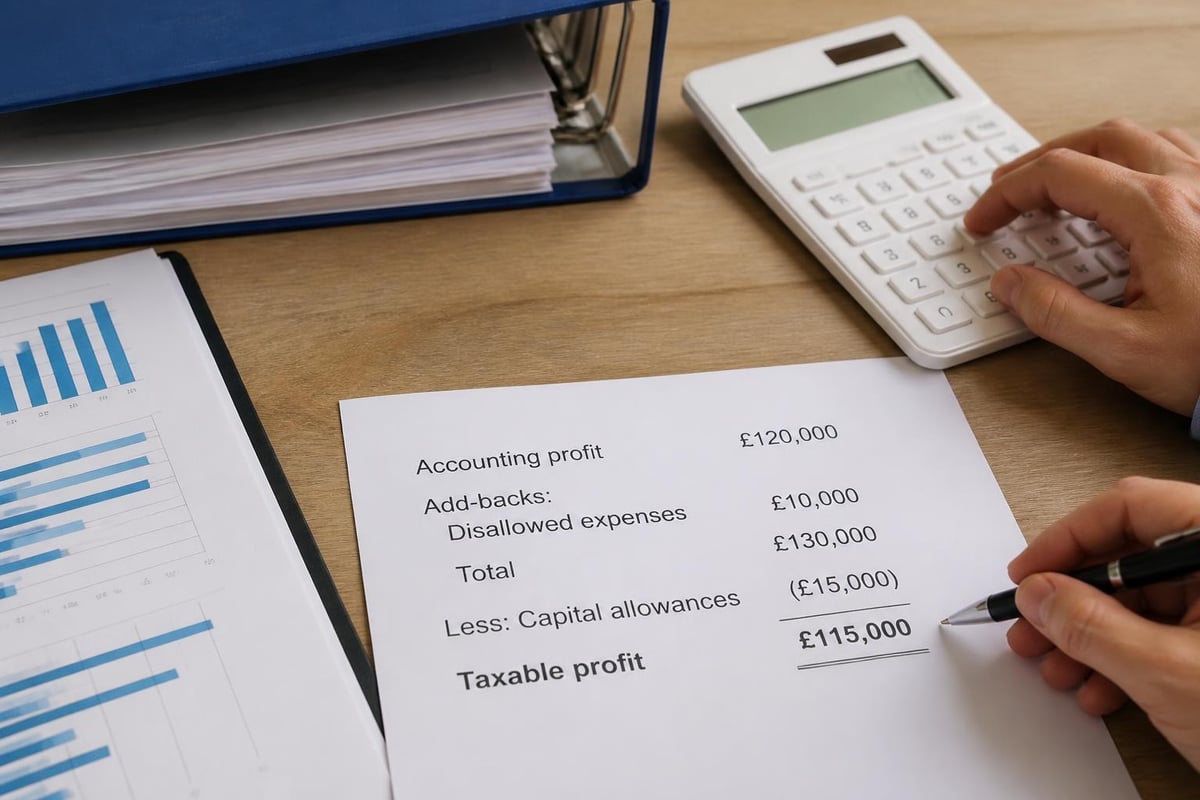
Common Adjustments to Profit
Your accounting profit (shown in your profit and loss account) almost never equals your taxable profit. Common adjustments include:
- →Adding back depreciation (not tax-deductible)
- →Deducting capital allowances (the tax version of depreciation)
- →Adding back entertaining expenses and certain legal fees
- →Deducting qualifying R&D expenditure or other reliefs
These adjustments are documented in your tax computation, which must accompany the submission of corporation tax returns. Getting these calculations wrong can mean overpaying tax or facing penalties for underpayment.
Common Mistakes That Delay Submissions
Even experienced business owners make errors that complicate the submission of corporation tax returns. Being aware of common pitfalls helps you avoid delays and penalties.
Mismatched Figures
Between accounts and CT600 that trigger automated HMRC queries
Incorrect Dates
Wrong accounting period dates causing rejection
Missing Pages
Supplementary pages for reliefs or specific situations
Forgotten Reliefs
Missing capital allowances or other tax reliefs

Penalties and Interest for Late Filing
Understanding the penalty regime helps you appreciate why timely submission of corporation tax returns matters so much.
HMRC penalty structure:
- •£100 immediate penalty if filed even 1 day late
- •£200 additional penalty at 3 months late
- •Daily penalties of £10 per day (up to £900) after 6 months
- •Further penalties of 10% of tax due or £3,000 (whichever is higher) after 12 months
These penalties apply even if you have no tax to pay. A dormant company still faces the full penalty regime if it fails to file on time. Interest on unpaid tax is charged from the original payment deadline (9 months and 1 day after your accounting period end) until the date you actually pay, currently at rates significantly higher than commercial borrowing rates.
Getting Help with Your Corporation Tax Return
For many business owners, the technical complexity and penalty risks make professional support worthwhile. The cost of accountancy services is typically far less than the value of tax reliefs claimed, time saved, and penalties avoided.
When choosing support for the submission of corporation tax returns, look for:
Qualified accountants
With recognised professional credentials
Cloud accounting expertise
To keep your records current year-round
Fixed-fee pricing
So you know costs upfront
Proactive tax planning
Not just compliance filing
Local knowledge
Of your business community and sector
Accountants who specialise in year-round support, rather than annual compliance-only services, provide the most value. They spot tax-saving opportunities throughout the year, not just at filing time.
Ready to Get Your Corporation Tax Return Right?
The submission of corporation tax returns is a legal requirement that every UK limited company must fulfil, but it doesn't have to be stressful or complicated. With proper planning, accurate record-keeping, and professional support, your annual filing becomes a routine part of running a compliant, well-managed business.
Figures UK work with businesses across Peterborough and Cambridgeshire to manage their corporation tax returns, accounts preparation, and year-round compliance through our fixed monthly fee services. We use Xero to keep your financial records accurate and submission-ready, so you can focus on running your business while we handle the compliance.
Get In Touch
Get In Touch With Us
Want a fixed monthly quote or a quick chat about switching accountants? Send us a message — we'll reply with clear next steps.
Worried about switching? Don't be.
You can move to Figures UK at any point in the year — no need to wait for year end. We handle the entire handover, including moving your records and transferring everything to HMRC, so the switch is seamless and stress-free for you.